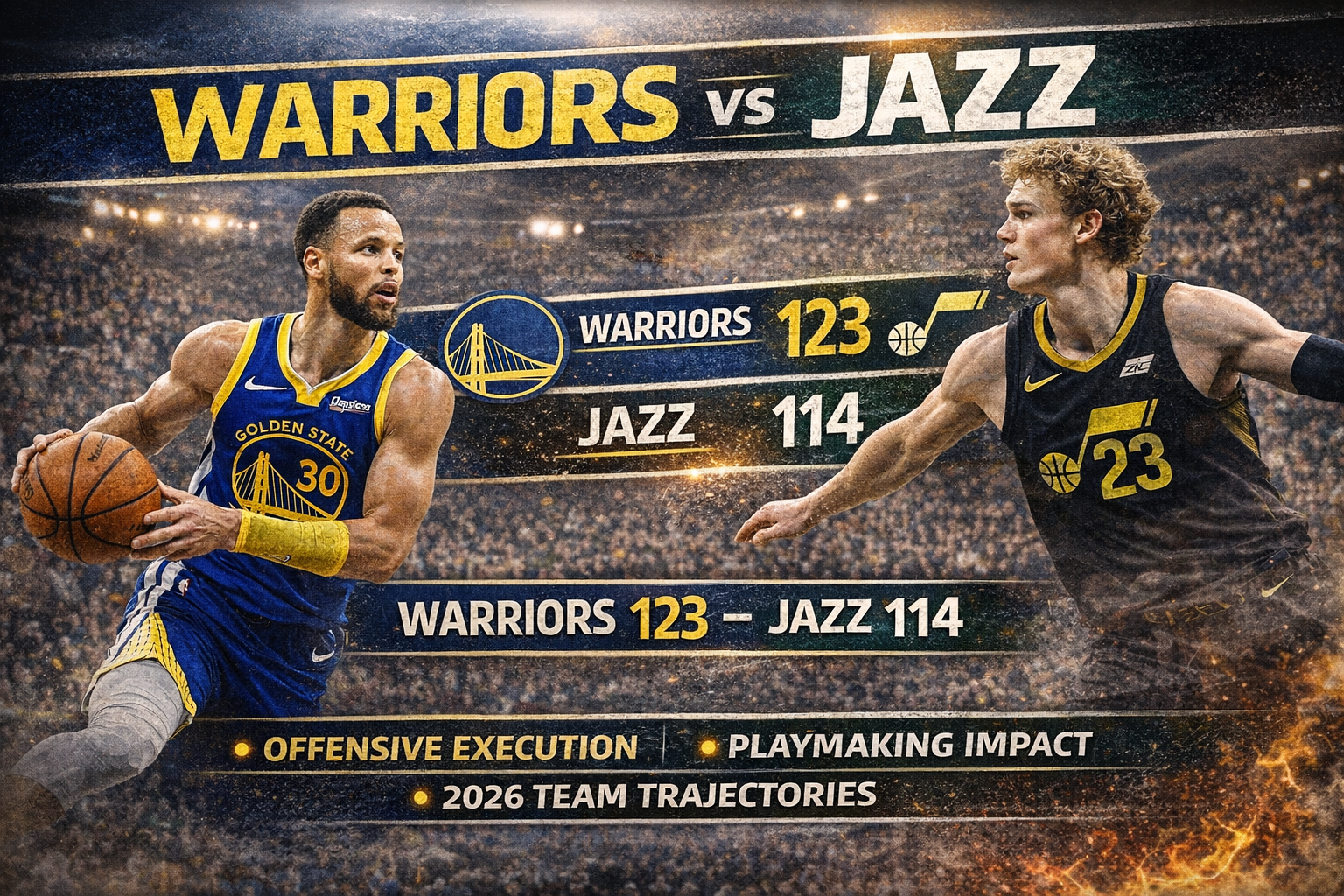
Rivalry and Context
The Golden State Warriors and Utah Jazz share a regular-season history that dates back decades, but the competitive balance has shifted significantly in recent years. Historically, the Jazz held the edge in head-to-head wins, though recent seasons have tilted toward Golden State’s modern offensive era. The Warriors entered the 2025-26 season with a veteran-led attack centered on spacing and three-point efficiency, while the Jazz focused on youth development and integrating new playmakers into a rebuilding rotation.
Pre-Game Narrative
Leading into their latest meeting on January 3, 2026, the Warriors held a superior record and offensive profile. Their spacing and scoring threats remained among the league’s upper tiers when healthy. The Jazz, meanwhile, struggled to sustain consistency, particularly on defense and in close games, often relying on perimeter creation from key scorers. Recent performance trends favored Golden State’s ability to impose tempo and shot creation while, for Utah, roster instability and defensive instability were persistent challenges.
First Half: Execution and Early Patterns
The initial phases of the game reflected both teams’ philosophical identities. Golden State emphasized ball movement and spacing, locating open perimeter opportunities and probing interior rotations to create high-value looks. Utah countered with aggressive perimeter shooting and secondary drives intended to disrupt the Warriors’ defensive spacing. While both teams traded baskets, Golden State slightly edged momentum by converting critical possessions and limiting turnovers in transition.
Second Half: Offensive Adjustment and Preparation
Golden State’s second-half execution reflected systematic patience from coach Steve Kerr’s schemes. The Warriors sustained offensive balance by leveraging off-ball screening, alignment shifts to create isolation advantages, and consistent three-point attempts when defenders over-helped. Utah’s defense, which had shown promise earlier in the season, faltered partly due to the Jazz’s personnel gaps and difficulties contesting shooters beyond the arc.
Stephen Curry’s scoring dominance was a defining factor. He scored 31 points in this matchup, converting multiple triples and forcing strategic defensive rotations that opened additional scoring for teammates. Utah’s offense was bolstered by contributions from Lauri Markkanen; however, the Jazz lacked sufficient secondary creation when Golden State’s defense concentrated pressure on initial ball handlers.
Personnel Impact
Golden State’s offense hinged on elite shooting and spacing. Curry’s ability to score efficiently from flood threats forced the Jazz into reactive defensive choices. Utah’s offensive leaders created opportunities, but structural inefficiencies surfaced in clutch situations. The Warriors’ bench provided valuable minutes that helped sustain scoring runs and absorb defensive miscues.
For Utah, reliance on perimeter scoring without proportional interior support weakened their ability to control possessions late in the game. The Jazz’s roster construction—still oriented toward growth rather than contention—was a factor in late-game execution under pressure.
Tactical Takeaways
This game reinforced several strategic truths for both teams:
- Golden State’s offensive architecture thrives on spacing and unconventional ball movement. When Curry renders defenses helpless, the spacing allows role players to exploit open lanes or catch-and-shoot situations.
- Utah’s progress depends on defensive cohesion and efficient secondary scoring. Without consistent stop rates and balanced offensive outputs from multiple angles, the Jazz struggle to keep pace with higher-tier offensive teams.
Golden State’s victory of 123-114 was influenced by these tactical themes, illustrating why such games often see elevated scoring and highlight reel possessions.
Broader Implications
From a standings and playoff outlook perspective, this win supported Golden State’s effort to stabilize its position amid a competitive Western Conference. It also underscored Utah’s ongoing need to refine defensive identity and cultivate more balanced offensive support, particularly in transition and late-game sequences. Warriors’ consistency against teams like the Jazz reinforces their brand of high-variance offense as a weekly standard, while Utah’s developmental process remains a long-term commitment.
Conclusion
The Warriors vs Jazz matchup showcased a clear offensive juxtaposition: elite spacing and shot creation from Golden State against a rebuilding Jazz squad seeking identity and cohesion. The final result reflected not only execution on the night but also the broader trajectories of the respective franchises. For the Warriors, the game reaffirmed their competitive standing; for the Jazz, it highlighted areas for growth in defensive consistency and secondary playmaking.