1. Why this game mattered before the opening tip
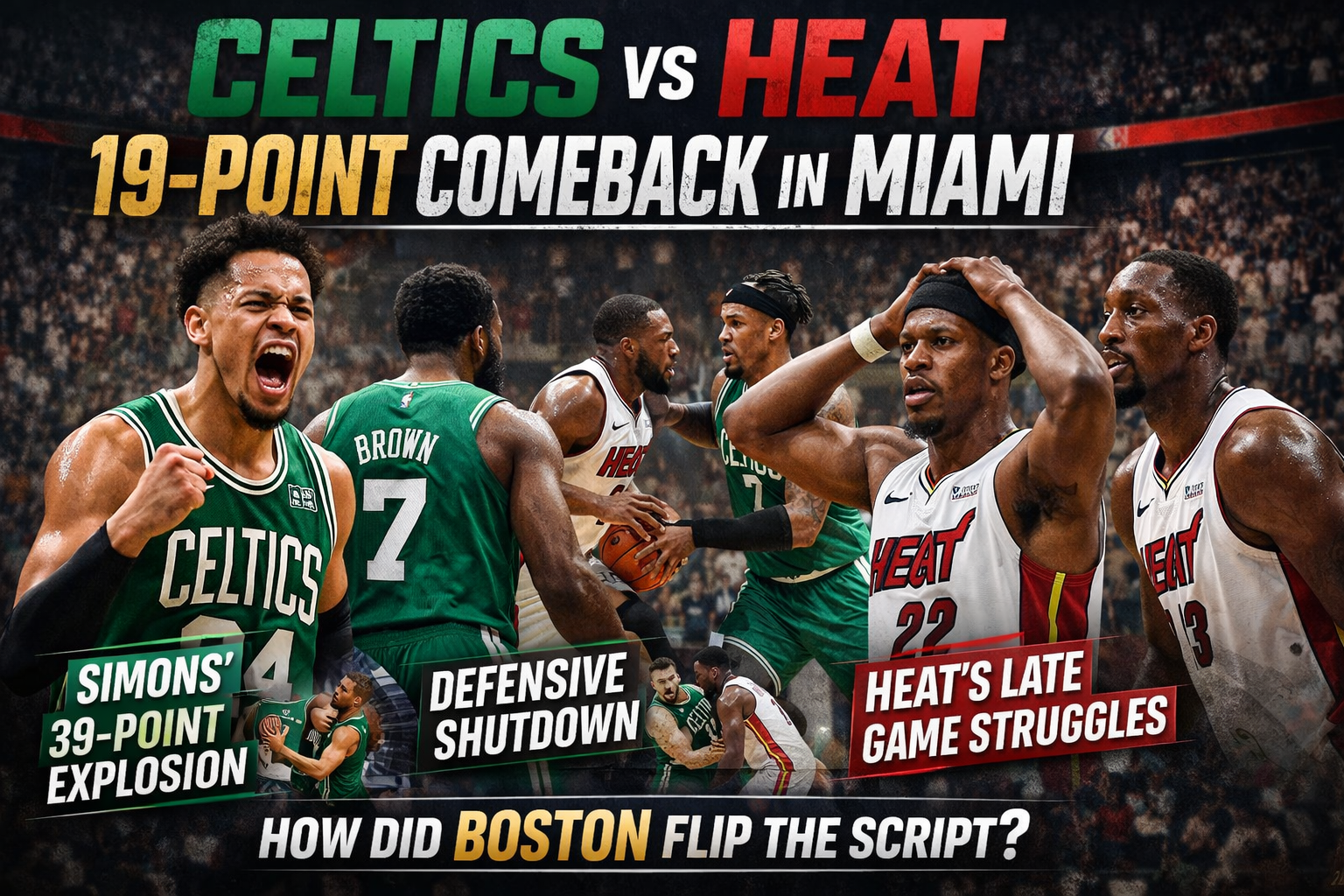
Boston’s 119-114 win in Miami on January 15, 2026, was not just another regular-season result. It was a stress test for both teams’ identities: the Celtics trying to sustain contender habits while shorthanded, and the Heat trying to translate a strong first-half script into a clean finish against a high-end opponent. The scoreboard tells you Boston completed a 19-point comeback and improved to 25-15 while Miami fell to 21-20, but the more useful story is how the game swung from pace and transition to half-court execution and late-game decision-making.
A key part of the context was availability. The NBA’s official injury report listed Jayson Tatum as out due to a right Achilles repair, forcing Boston into different lineup and scoring equations than their usual blueprint.
2. Miami’s first-half script: pace, flow, and early shot quality
For roughly 20 minutes, Miami played the type of game it wants against Boston: fast, decisive, and fueled by early offense. The Heat blitzed the start with an 18-4 opening and were up 36-25 after the first quarter, including a 28-9 surge that immediately put Boston into chase mode.
Two statistical signals explain why Miami’s opening looked so comfortable.
First, transition created separation. Reuters credited Miami with a 15-0 fastbreak points edge in the first half, a massive margin that usually correlates with control of tempo and cleaner looks before a defense is set.
Second, the Heat’s shot-making matched the pace. In the first half they shot 51.1% from the field and hit 10 of 23 threes (43.5%), per Reuters, which is exactly the kind of efficiency that makes a lead feel safe even if it is not.
At halftime, Miami led 64-54. Even after Boston briefly trimmed the margin (Miami’s lead dipped to 38-34), the Heat were able to reassert themselves, largely because they had multiple creators producing advantages without needing extended isolation.
3. Boston’s problem early: the “quality possession” gap
When a team falls behind by 19, the temptation is to blame effort. Effort can be part of it, but the more actionable diagnosis is usually possession quality.
Boston’s first-half possessions were too often “one advantage and done.” Whether the initial action created a small edge or not, Miami’s defense and activity pushed Boston into late-clock attempts or into shots that did not generate secondary breakdowns. Even when Boston scored, they were not consistently stacking stops and clean half-court trips, which is how you prevent a run from turning into a deficit you spend the whole night trying to erase.
This is where the Tatum absence matters tactically, not just numerically. Without a primary wing who can bend the defense on demand, Boston’s offense is more dependent on collective spacing, quick decisions, and someone catching fire to create a gravity event. On this night, that “gravity event” arrived late and came from the bench.
4. The turning point was not one play. It was a slow squeeze on Miami’s options
Miami still led 93-83 after three quarters, and Boston entered the fourth down 10.
From there, the game changed in a way that is familiar in close games against elite teams: the menu shrinks.
In the first half, Miami’s offense was wide. They were running, shooting early, and getting contribution across multiple actions. In the fourth, Boston steadily narrowed Miami’s choices. The most telling individual stat: Bam Adebayo finished with 22 points, but scored only five in the second half, according to Reuters.
That does not happen by accident. It usually reflects a mix of stronger point-of-attack containment (which reduces easy downhill entries), more physicality on catches, and better help timing that makes interior touches feel crowded. You do not need a single schematic silver bullet. You need repeated possessions where the offense feels one beat slower.
Boston also did the simplest comeback thing well: they won the fourth quarter by a landslide, outscoring Miami 36-21.
That margin almost always includes a defensive component, because even hot shooting rarely sustains a 15-point swing without stops.
5. The Simons swing: shot creation plus the hidden value of attention
Anfernee Simons’ box-score line is loud: 39 points off the bench, with 18 in the fourth quarter.
But the most important part of his performance was not simply that he made shots. It was how Miami had to react to him.
Late in the fourth, Reuters noted Simons scored 11 straight Boston points, and when Miami finally committed a double-team, Simons found Sam Hauser for a go-ahead three with 5:21 left.
That sequence is the anatomy of a comeback: one player forces the defense to break its rules, and the game flips from “difficult shot-making” into “created shot quality.”
From there, Boston’s closing execution was cleaner. ESPN’s recap highlights that Jaylen Brown’s three with 4:05 remaining put Boston ahead for good.
That matters because it signals Boston did not merely steal the lead on a heater; they backed it up with a composed finishing stretch.
6. The possession math that decided it
If you want the simplest statistical explanation for how Boston won despite trailing most of the night, start with possessions and free points.
From ESPN’s team totals:
- Boston shot 41-for-91 overall, 13-for-39 from three, and 24-for-25 at the line.
- Miami shot 39-for-87 overall, 15-for-42 from three, and 21-for-27 at the line.
Miami actually made more threes (15 vs 13). So where did Boston manufacture the edge?
- The free-throw gap in makes
- Boston made 24 free throws; Miami made 21. That is a three-point cushion in a five-point game.
- The rebounding gap, especially on the offensive glass
- Boston won rebounds 51-40 and grabbed 18 offensive boards to Miami’s 12.
- Those extra possessions are comeback fuel because they create second-chance threes, kick-out sequences, and fouls drawn against a defense that is already rotating.
- Miami’s early transition edge did not persist
- Miami’s first-half fastbreak dominance (15-0) did not translate into a stable late-game advantage. Once the game tilted into more half-court possessions, the Heat had fewer easy points to buffer against Boston’s surge.
7. Miami’s late offense: why it stalled, and what was missing
There are two layers to Miami’s fourth-quarter collapse: execution and availability.
On execution, Miami struggled to get the same variety of advantages they created earlier. When a lead shrinks, teams often start playing “protect the lead” basketball: slightly slower pace, slightly safer actions, and a higher reliance on individual shot-making. Against a locked-in defense, that can turn a comfortable lead into a series of contested jumpers.
On availability, Reuters reported Miami played without starting point guard Davion Mitchell (shoulder) and wing Jaime Jaquez Jr. (knee). It also noted Mitchell led the Heat in assists at 7.3 per game, while Jaquez was producing 15.9 points and 4.6 assists and was in the Sixth Man conversation.
When two connectors like that are missing, your late-game offense can become more predictable, especially if the opponent is forcing the ball into narrower lanes.
Miami still got big nights from Norman Powell (26) and from Tyler Herro and Bam Adebayo (22 each).
The issue was not that the Heat lacked scorers. It was that the scoring did not come in the right sequence, with the right spacing, once Boston ramped up pressure and denied easy entries.
8. What this says about Boston without Tatum
The Celtics’ most encouraging takeaway is not just resilience. It is the blueprint they flashed for surviving games where the offense is not smooth early.
- They can win ugly stretches by dominating the glass and living at the line.
- They can create a “star moment” from a bench scorer when the offense needs gravity.
- They can close with defensive intensity that turns a game into a grind.
Tatum’s absence remains the central long-term question. The injury report labeled him out due to Achilles repair, and Reuters reported in 2025 that the Celtics announced he underwent surgery to repair a ruptured right Achilles tendon.
But games like this show Boston can still build wins from fundamentals: shot quality created by pressure, extra possessions, and late composure.
9. What Miami should take forward
For the Heat, the lesson is not “you blew it.” The lesson is “your margin for error is smaller when you stop generating easy points.”
When Miami was running, they were in control. When Boston forced more half-court possessions, Miami needed a more reliable late-game mechanism: either a go-to set that consistently creates a paint touch, or a counter that punishes aggressive help without turning into rushed threes.
The good news is that this game is diagnostic. It shows Miami exactly where the offense thinned out, and it does it against a familiar opponent that will likely be relevant in the East.
10. Looking ahead: the rivalry is not done this season
Boston and Miami still have at least one more meeting scheduled on February 6, 2026 in Boston.
If this game becomes a mini-series narrative, the chess match will revolve around two questions:
- Can Miami keep the game fast enough to avoid extended half-court droughts?
- Can Boston keep manufacturing extra possessions and late-game shot quality if opponents sell out to stop the “hot hand” the way Miami eventually did with Simons?
Boston answered those questions for one night in Miami. The next meeting will reveal whether these were one-game swings or the start of a tactical pattern.