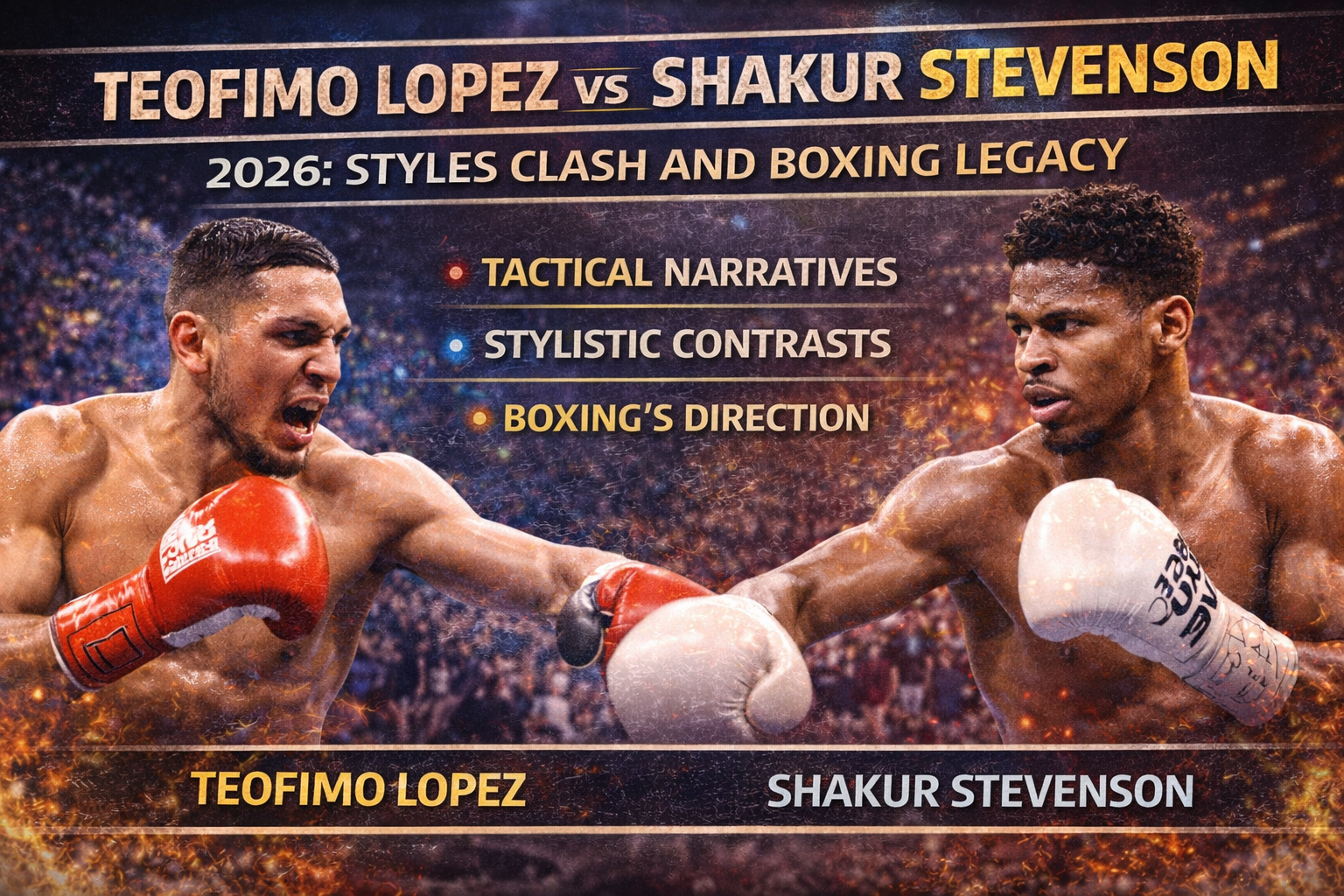
Context: Why This Card Mattered
The card headlined by Teofimo Lopez and Shakur Stevenson arrived at a moment when boxing is increasingly driven by clarity at the top of divisions. Both fighters represent distinct archetypes of modern championship boxing. Lopez embodies volatility, power, and emotional momentum. Stevenson represents technical control, defensive mastery, and strategic restraint.
Even without sharing the same bout, placing them atop the same card framed the night as a comparison exercise. Fans, analysts, and promoters were not just watching results. They were evaluating which style carries more long-term authority in today’s boxing economy.
Teofimo Lopez: Controlled Aggression Under Scrutiny
Lopez entered the card with pressure that extended beyond his opponent. His recent career arc has been defined by dramatic swings: elite victories followed by uneven performances. On this night, the emphasis was on discipline.
Lopez’s approach centered on measured aggression rather than reckless offense. He picked moments to explode, particularly behind counter right hands and sudden combination bursts. When effective, this style reminded observers why he remains one of the most dangerous fighters in the sport. When less effective, it exposed lingering issues with pacing and defensive positioning.
The key takeaway was not dominance, but intent. Lopez showed signs of understanding that elite-level sustainability requires structure, not just athletic superiority.
Shakur Stevenson: Technical Supremacy as a Statement
Stevenson’s performance reinforced his reputation as one of the sport’s purest technicians. His movement, distance control, and anticipation turned the ring into a controlled environment where opponents were forced to react rather than initiate.
What stood out was not merely defensive excellence, but offensive efficiency. Stevenson selected shots with precision, minimized risk, and steadily accumulated control over rounds. Critics often argue that his style lacks spectacle. This card challenged that critique by framing dominance itself as entertainment.
Stevenson’s showing sent a clear message to the lightweight and super lightweight landscapes: beating him requires disrupting his rhythm, not outworking him within it.
Stylistic Contrast: Power vs Precision
The value of this card rested in contrast. Lopez fights in moments. Stevenson fights in sequences. Lopez thrives on chaos. Stevenson thrives on predictability that he controls.
From a strategic perspective, the night highlighted a recurring boxing truth. Power creates highlights, but precision creates careers. The comparison did not diminish Lopez’s threat level. Instead, it clarified the margin for error between fighters who rely on force and those who rely on control.
The Undercard: Depth Over Filler
Beyond the main attractions, the undercard played a crucial role in elevating the event’s credibility. Competitive matchups, emerging contenders, and meaningful divisional implications ensured that the card felt curated rather than padded.
This matters in an era where boxing cards are often criticized for thin depth. The supporting bouts reinforced the idea that elite events must offer narrative value from start to finish, not just at the top.
Marketability and Boxing’s Direction
The card also reflected boxing’s current tension between marketability and meritocracy. Lopez remains a magnetic figure, driven by emotion and volatility. Stevenson represents long-term brand stability built on consistency and mastery.
Promoters benefit from both. The sport benefits most when these paths eventually converge. This event nudged boxing closer to that convergence by placing contrasting stars on equal billing, allowing performance to shape perception.
What This Card Means Going Forward
For Lopez, the night suggested a recalibration. He remains elite, but his ceiling depends on embracing structure without losing edge. For Stevenson, the performance reinforced inevitability. He continues to look like a fighter whose prime will be measured not by drama, but by control.
At a broader level, the card reaffirmed that boxing’s future is not tied to a single style. It is tied to fighters who can define their identity clearly and execute it under pressure.
Conclusion
The Teofimo Lopez vs Shakur Stevenson card succeeded because it invited comparison without forcing confrontation. It allowed two elite fighters to express their philosophies in parallel and let the audience decide which carries greater authority in the modern sport.
In doing so, the event elevated discussion beyond wins and losses. It framed boxing as a strategic discipline shaped by choices, restraint, and timing. That is why this card will be remembered as more than a trending headline. It was a statement about where elite boxing stands, and where it is headed.