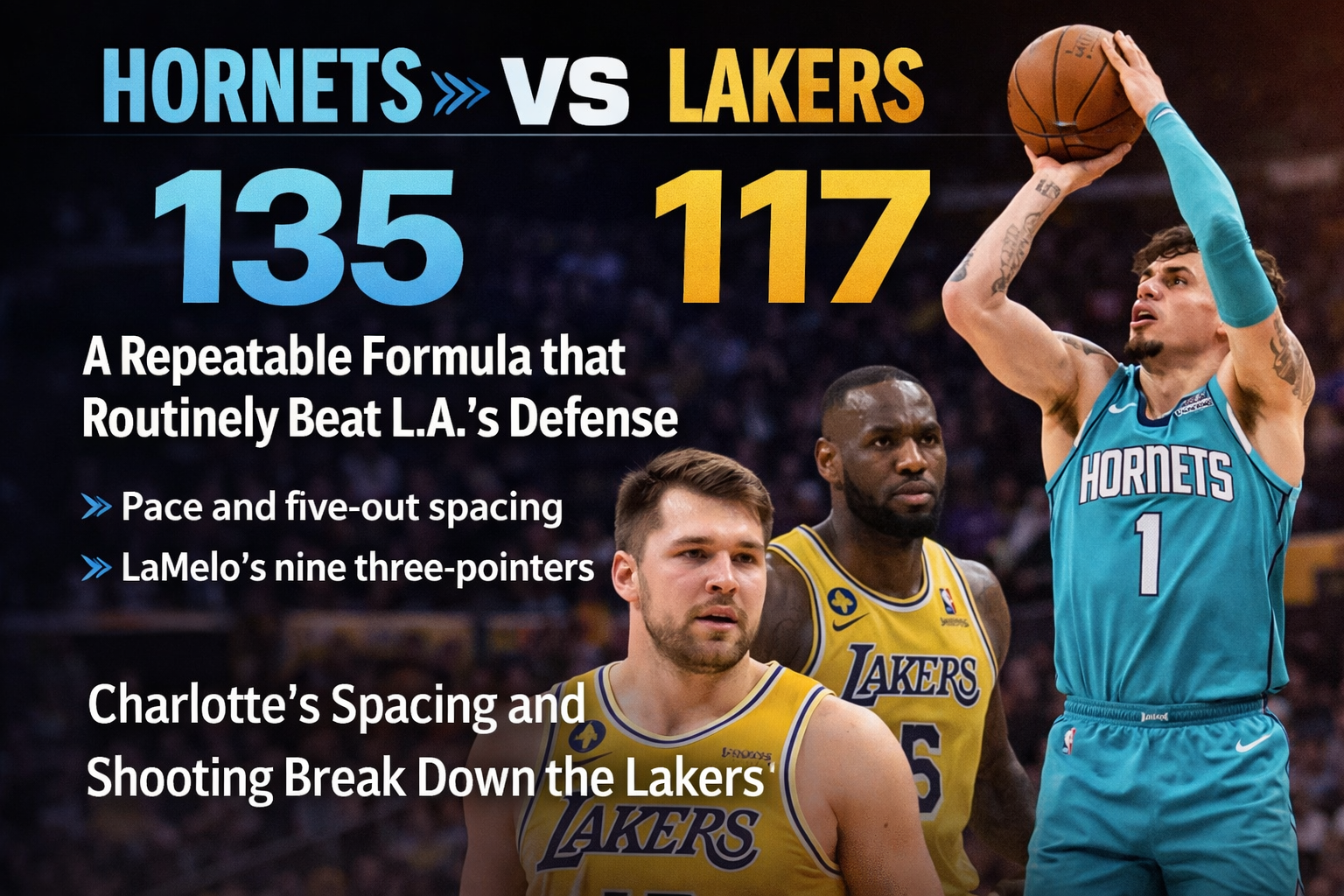
A blowout that explains more than it surprises
The Charlotte Hornets walked into Crypto.com Arena on January 15, 2026 and left with a 135–117 win that felt bigger than a single regular-season result. The final margin was loud, but the more important takeaway was how it happened: Charlotte didn’t merely ride a heater—they created a game environment where good shots were inevitable, and the Lakers’ defensive habits turned every small crack into a wide opening.
This matchup also arrived with two teams moving in opposite emotional directions. Los Angeles had been wobbling after a strong start, while Charlotte—despite its record—had begun to look more coherent and dangerous since the new year. That context matters, because this game wasn’t decided by a single superstar burst. It was decided by which team could impose a clearer identity for 48 minutes.
The shape of the game: one quarter that flipped everything
On the scoreboard, the game reads like a classic “first-quarter tease, then reality hits.” The Lakers scored 39 in the opening period and led 39–30 after one. At one point early, they were up 13.
Then the entire night turned in the second quarter—16 points for L.A., 34 for Charlotte. That single quarter created the platform for everything that followed. Reuters described the Hornets’ decisive middle stretch as a 34–16 second-quarter advantage, with the Lakers shooting just 27.8% in that period.
If you want one “turning-point” sequence to frame the analysis, it’s this: Charlotte’s surge wasn’t just a run, it was a pattern—the Hornets repeatedly created either (1) an advantage off the dribble that forced help, or (2) a clean catch-and-shoot look before the Lakers could recover. Once the Lakers’ second-quarter offense stalled, Charlotte’s confidence on the other end exploded.
Charlotte’s offensive blueprint: spacing first, decisions second, shotmaking last
The simplest stat that captures Charlotte’s plan is the three-point volume and accuracy: 20-for-43 from three (46.5%). But the deeper story is that those threes weren’t random. They were the result of three repeatable ideas:
- Early offense and pace
- Even when L.A. scored, Charlotte often pushed the ball quickly—forcing cross-matches, late communication, and imperfect coverage. That doesn’t always show up as “fastbreak points” alone (Charlotte had 17 to L.A.’s 22), because the real value is early-clock advantage creation: drag screens, quick reversals, and a defense that hasn’t organized its help rules yet.
- Spacing that stretches the Lakers’ help
- Charlotte consistently placed shooting threats in the corners and on the wings, which punishes the most common modern defensive habit: “help a step, then recover.” If the recover step is late by a fraction, it’s a three. If the help step doesn’t happen, it’s a layup or a paint touch. Charlotte scored 56 points in the paint while still launching 43 threes—proof that the outside game wasn’t a fallback, it was a lever that opened the inside.
- Ball movement that turns rotations into open shots
- This is where the Hornets were ruthless. They finished with 34 assists to the Lakers’ 18. That gap isn’t just “unselfishness”—it’s evidence that Charlotte consistently created advantage, forced a rotation, and then made the next pass on time. When teams do that, defenses don’t “get stops,” they just hope you miss.
The LaMelo Ball game: nine threes, but the timing was the weapon
LaMelo Ball’s line—30 points, 11 assists—was the headline. The detail that matters is when it arrived: Ball scored 27 of his 30 in the second half, hitting eight threes after halftime and tying his career high with nine total threes.
That timing is tactical. In the first half, Charlotte’s offense built the scaffolding: touches in the paint, kick-outs, and enough movement to make the Lakers chase. In the second half, Ball’s shotmaking turned that chase into panic. Once a defense starts feeling like every screen is a potential three, it begins to compromise:
- Bigs creep higher to contain the pull-up threat → driving lanes open.
- Help defenders “hug” shooters to prevent kick-out threes → rim protection weakens.
- Closeouts get frantic → one pump fake becomes an advantage chain.
Ball didn’t just make shots; he changed the Lakers’ defensive posture. And when he hit back-to-back threes late (part of a closing push that ballooned the lead), it felt less like a hot streak and more like the inevitable final step of a plan that had already worked for 40 minutes.
The supporting cast: Charlotte won the “second-best player” minutes
Big road wins often hinge on whether the star gets enough support to turn great possessions into separation. Charlotte got it in waves:
- Brandon Miller: 26 points
- Miles Bridges: 25 points
- Kon Knueppel: 19 points
This mattered because Los Angeles did receive major scoring from its top two—Luka Dončić (39) and LeBron James (29)—but the Lakers’ secondary creation didn’t consistently bend Charlotte’s defense the way Charlotte’s secondary scorers bent L.A.’s.
In other words: the Lakers had star production; the Hornets had star production plus system production. Over four quarters, “system points” usually win.
Why the Lakers’ offense wasn’t enough, even with 39 from Luka
Dončić scoring 39 typically means you controlled the game’s math. Not here. The Lakers’ problem wasn’t only missed shots; it was that their offense didn’t consistently protect their defense.
When the Lakers’ offense bogged down in the second quarter, it produced the exact outcome Charlotte wanted:
- fewer organized defensive matchups in transition,
- more scrambling after long rebounds,
- and more situations where a single advantage led to a high-value three.
Even if you ignore the second-quarter shooting percentage, the quarter’s identity was clear: the Lakers lost their rhythm, and Charlotte turned that into tempo.
The defensive diagnosis: rotation mistakes, not just “bad effort”
It’s easy to call a 135-point concession an effort issue. Effort might be part of it, but the numbers point to something more structural:
- Hornets shot 54.3% from the field and 46.5% from three
- Hornets out-assisted the Lakers 34–18
- Hornets won the rebound battle 50–35
Those are “process” stats. They suggest the Lakers were frequently a step late in coverage and consistently second-best on possession battles (particularly on the glass), which compounds quickly when the opponent is already shooting well.
And note the cruelty of Charlotte’s math: when a team makes 20 threes, every defensive mistake gets priced at three points instead of two. A handful of missed rotations becomes a double-digit lead before you realize it.
The closing stretch: when the game stopped being competitive
Los Angeles did make a push—cutting the deficit to four late in the third (93–89). That moment mattered, because it tested whether Charlotte’s hot shooting would cool and whether the Lakers could string together stops.
Instead, Charlotte answered with composure: they rebuilt the margin entering the fourth (104–93) and later slammed the door with a 14–3 run to go up 123–106, before Ball’s late threes removed any remaining doubt.
That sequence is often where young teams wobble. Charlotte didn’t. They executed—clean possessions, quick decisions, and shots that came from the same advantage creation that had worked all night.
What this game means going forward
For Charlotte: This is the type of win that can travel. Not because 46.5% from three is sustainable every night, but because the shot profile is. If your offense regularly generates 40+ threes plus consistent paint pressure, you will beat good teams when the threes fall—and you’ll stay competitive even when they don’t. The Hornets’ recent form since early January hints they’re finding a clearer identity.
For Los Angeles: The Lakers’ recent stumble is no longer a “one bad night” story. Reuters noted they’ve lost four of five, sliding after a strong early record. When you allow an opponent to play with this much rhythm—and when your worst quarter is a 16-point collapse—you’re not just losing possessions, you’re losing control of the game’s terms.
If the Lakers want a fast fix, it starts with two priorities:
- Defensive communication and closeout discipline (take away the easy threes first).
- Offensive structure in the non-star minutes (because empty trips fuel the opponent’s pace).
Because the Hornets didn’t win this game by doing something exotic. They won by doing the basics—spacing, passing, shooting—at a level that made the Lakers’ current cracks impossible to hide.