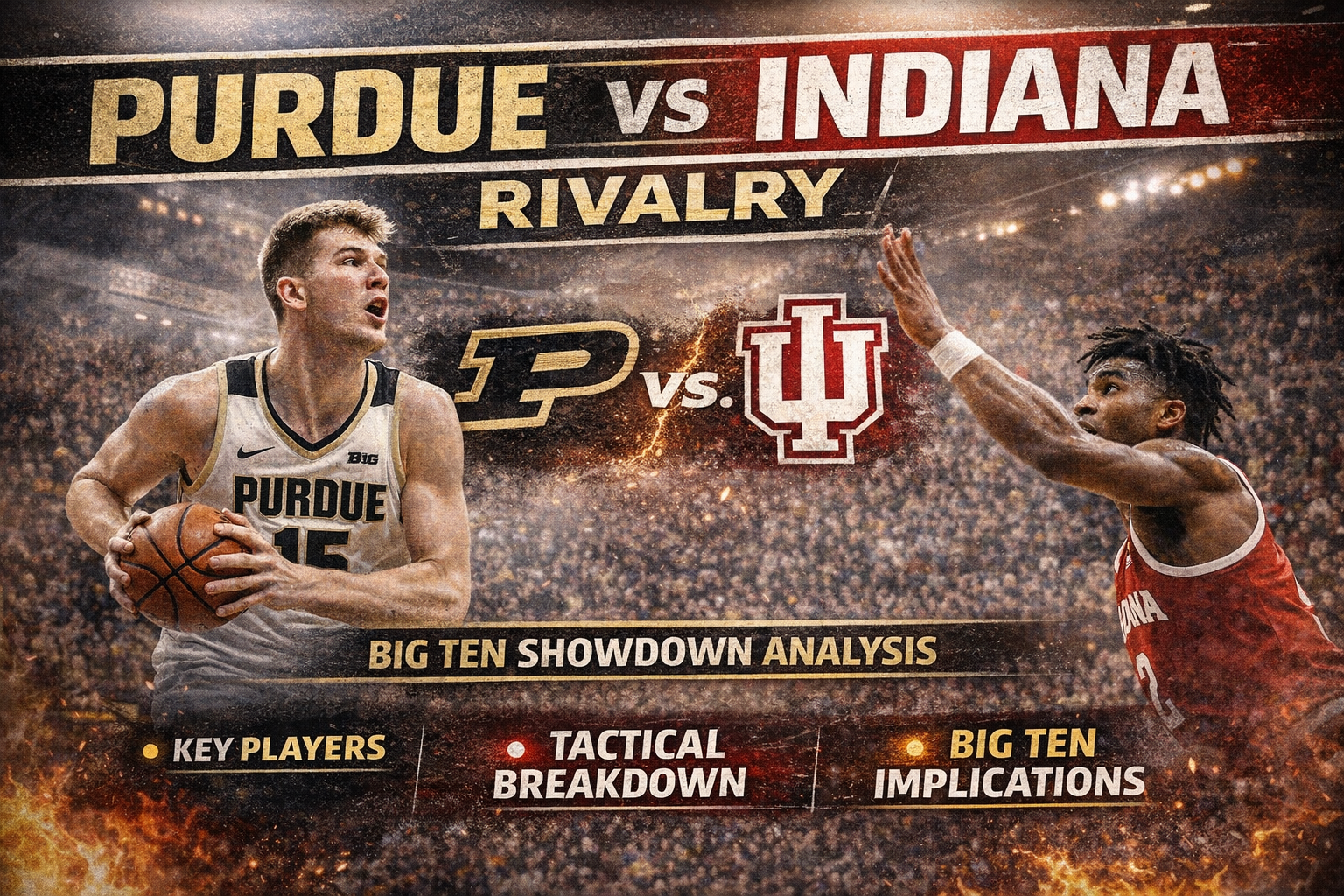
Introduction: Rivalry Context
The Purdue Boilermakers and Indiana Hoosiers have one of the oldest and most intense rivalries in college basketball. The rivalry dates back to the early 20th century and reflects geographic proximity, fan passion, and contrasting program identities. Historically, Purdue holds the edge in head-to-head results, but Indiana has enjoyed significant success and memorable wins over the decades. This context elevates every meeting beyond a typical conference game.
Pre-Game Landscape
Heading into the latest matchup, Purdue sat among the more consistent teams in the Big Ten with a 17-3 record and solid national standing. Still, the Boilermakers had recent performance concerns, including consecutive losses that exposed defensive lapses and offensive inconsistencies. Indiana, for its part, was battling for relevance, fighting injuries and uneven production but boasting home-court advantage and veteran scorers capable of changing the rhythm of games.
Statistically, Purdue’s strengths centered around interior size, rebounding potential, and efficient two-point offense. Indiana relied more on perimeter shooting and backcourt scoring, making defensive attention to space a priority for the Boilermakers. The tactical matchup was clear: if Purdue could impose its physicality and handle Indiana’s guards, it would control tempo; if Indiana could trigger transition offense and make shots from range, the Boilermakers’ interior focus could be undermined.
First Half: Tactical Execution and Shifts in Momentum
Early in the contest, the pacing reflected both teams’ philosophical differences. Purdue worked methodically inside, prioritizing post touches and high-percentage shots. Indiana countered with quicker ball movement and attempts to stretch the defense, a strategy designed to pull Purdue’s big men away from the rim.
Purdue won initial possession battles and influenced shot quality through size advantage. Indiana’s guards, however, found early success attacking closeouts, earning foul opportunities and keeping the score tight. By halftime, neither team had established decisive control, setting the stage for adjustments on both ends.
Second Half: Execution Under Pressure
The second half highlighted the coaching contrast. Purdue’s staff emphasized rebounding and limiting turnovers. Indiana focused on selective aggression, pushing transition and exploiting mismatches. The Boilermakers’ ability to control offensive rebounds translated into sustained possessions that tested Indiana’s defensive discipline.
Indiana’s perimeter shooting was a double-edged sword. In spurts, it allowed runs that kept the game within reach. At other times, erratic spacing led to rotations that Purdue exploited for interior scoring and second-chance points. Ultimately, efficiency at the rim and bench contributions became decisive factors in the closing stages.
Key Player Performances
Purdue relied on consistent scoring from its veterans, particularly in the paint and mid-range. Trey Kaufman-Renn and Oscar Cluff influenced the offensive glass, giving Purdue extra possessions that frustrated Indiana’s defensive schemes. Indiana’s backcourt leaders carried responsibility for initiating offense and creating separation in tight moments, but inconsistent shot-making limited their late-game impact.
Purdue’s bench also played an outsized role, providing energy on defense and crucial buckets during Purdue’s most effective stretches. Indiana’s reserves contributed but were less consistent, reflecting a trend where depth impacted the balance of possession and momentum.
Tactical Takeaways
From a tactical standpoint, the game reinforced several enduring lessons in college basketball:
- Interior dominance paired with offensive rebounding can offset perimeter threats if executed with discipline.
- Controlling turnovers and transition defense are critical when facing teams that sporadically go on scoring runs.
- Depth matters. Bench scoring and defensive intensity often define performance in closely contested rivalry games.
These lessons will shape how both coaching staffs refine strategies as the season progresses into the most competitive stretch of conference play.
What It Means for the Big Ten
The outcome affected Big Ten standings and postseason narratives. For Purdue, a strong performance—even in a loss or narrow win—reinforces its status as a contender capable of adapting. Indiana’s ability to compete against ranked teams reflects growth and signals that its development trajectory could challenge preseason expectations. Both programs will need consistent execution, especially on defense, to sustain momentum at the top of a deep conference.
Conclusion: Beyond a Single Result
This latest Purdue vs Indiana matchup was more than a single game result. It was a reflection of institutional identity, coaching adaptation, and player development. The rivalry’s ongoing narrative continues to highlight how each program balances tradition with the evolving demands of modern college basketball.
In evaluating the broader impact, what matters most is not merely who won or lost. It is how each team can translate lessons learned into improved consistency, competitive grit, and strategic clarity as the Big Ten season intensifies.