Context: why this matchup felt like March in January
This was not a “good win” or a “tough loss” type of night. It was a top five collision with real Big Ten title leverage: No. 3 Michigan (19-1, 9-1) vs No. 5 Nebraska (20-1, 9-1), played at Crisler Center, and Nebraska entered unbeaten.
It was also historically loud from the Nebraska side of the ledger: the game was the first matchup between top five teams in Husker men’s basketball history.
Nebraska’s task got harder before the opening tip. The Huskers played without Braden Frager (ankle) and All Big Ten forward Rienk Mast (ill). That matters, not only because of missing production, but because it compresses minutes and lineup options in a game decided by a handful of possessions.
The first half: Nebraska’s perimeter punch meets Michigan’s interior efficiency
Nebraska’s blueprint was clear early: stretch the floor, win the math with threes, and make Michigan chase. The Huskers drilled 10 of 19 from three in the first half and shot 59.4 percent overall, opening an 11-point lead at their peak and taking a 50-48 advantage into halftime.
Pryce Sandfort and Jamarques Lawrence were the engines. They scored 20 points each, with Lawrence’s early run fueled by four first-half threes.
Michigan’s counter was not hot shooting, it was finishing. The Wolverines hit 19 of 29 in the first half (65.5 percent) and kept contact by living in the paint and on second chances rather than matching Nebraska’s volume from deep.
The second half: both teams went cold from three, so the game became about possessions
The second half flipped the shot-making script in a way that made every rebound, free throw, and turnover feel amplified.
Both teams cratered from three after the break: Nebraska went 1 for 13, Michigan also went 1 for 13.
So how did Michigan win a half where it shot just 25.0 percent from the field?
Three possession levers swung it:
- Free throws
- Michigan: 14 for 17 at the line in the second half, 19 for 23 overall
- Nebraska: 1 for 2 at the line in the second half, 3 for 4 overall
In a three-point game where both offenses stalled from deep, Michigan’s ability to generate and convert free throws became its functional half-court offense.
- Rebounding and second chances
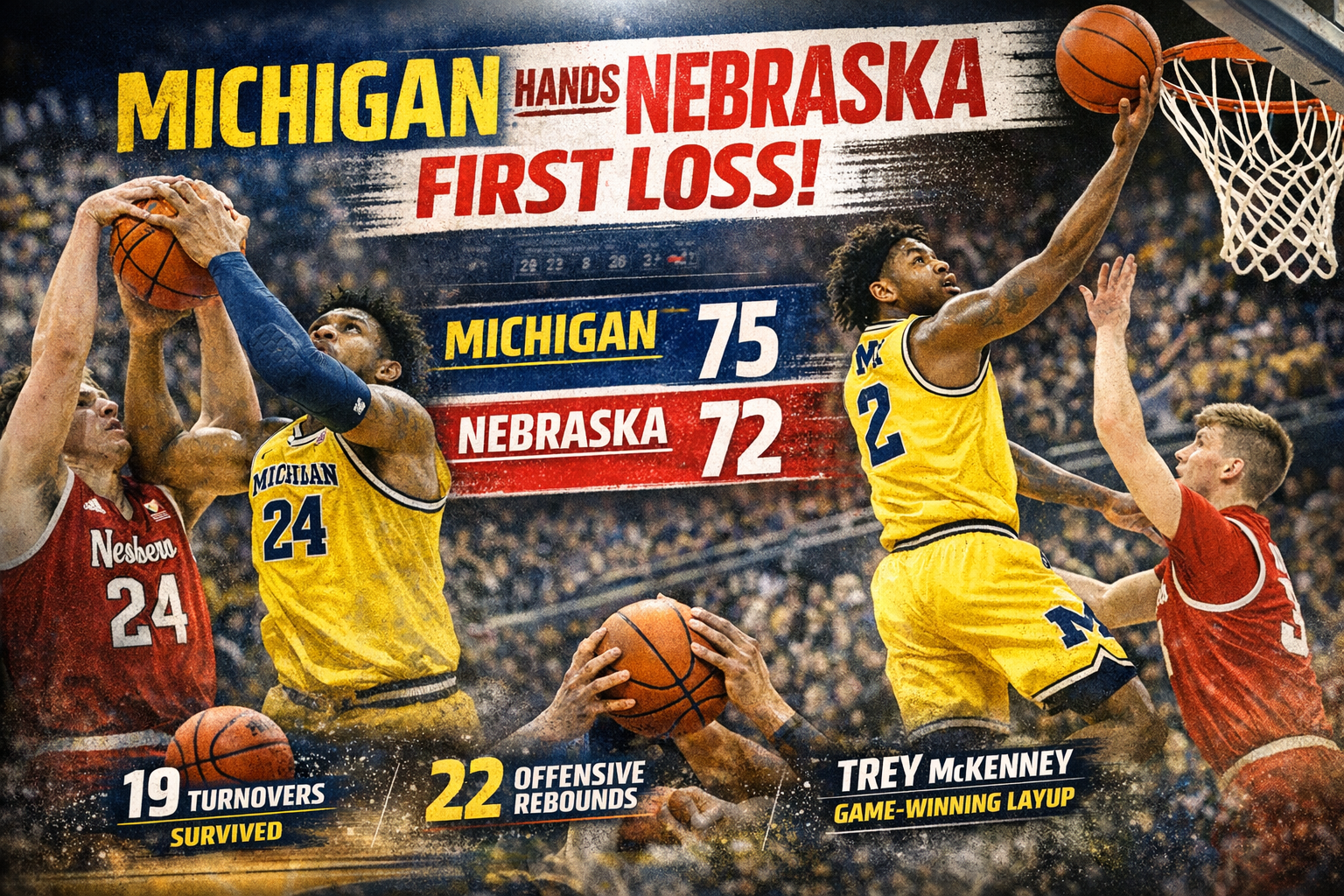
- Michigan: 35 rebounds, 14 second-chance points
- Nebraska: 23 rebounds, 5 second-chance points
Those extra possessions are the hidden margin in a game Michigan “should” have lost if you only look at turnovers and three-point percentage.
- Bench production
- Michigan received 22 bench points to Nebraska’s 6. In a matchup where Nebraska’s starters logged heavy minutes (three starters at 39 minutes), that bench differential is not cosmetic. It changes the energy level and the foul management late.
The tension point: Michigan won late, even though Nebraska led almost all night
If you want the cleanest summary of the game’s psychology, it is this: Nebraska led for 91 percent of the contest, Michigan for 5 percent.
Michigan basically won in the sliver of time that matters most.
The closing sequence captured the entire night. With the score tied 72-72, Trey McKenney made a gamble steal after a Michigan turnover, pushed the break, then turned a pump fake into a baseline drive and a go-ahead finish. UM Hoops described it as a two-play sequence that flipped the game’s emotional control.
Player level read: who bent the game
Morez Johnson Jr. was the stabilizer.
He posted 17 points on 5-of-6 shooting with 12 rebounds, and Michigan’s paint pressure started with his ability to score efficiently without needing rhythm threes.
Nebraska’s shot makers carried the first half, but ran out of margin.
Sandfort and Lawrence combined for 40, and Sam Hoiberg added 13, yet Nebraska finished with just four free throw attempts all game. That is a razor-thin path to close on the road when threes stop falling.
Michigan survived Elliot Cadeau’s high-variance night.
Cadeau had 7 assists but also 8 turnovers, a big driver of Michigan’s 19 total giveaways. The fact that Michigan won anyway tells you how dominant it was in the possession categories that do not show up in highlight packages.
Tactical takeaways that matter going forward
1) Michigan’s “bad win” profile is actually a good sign
A team that can win while losing the three-point battle (11 made threes for Nebraska vs 6 for Michigan) and coughing it up 19 times is not supposed to exist at the top of the sport unless it has a strong defensive and physical foundation.
Michigan’s margin came from repeatable things: defensive stops at the end, rebounding, paint scoring, and free throws. Those travel.
2) Nebraska’s spacing is real, but the roster context matters in crunch time
Nebraska generated quality three-point volume, but with Frager and Mast out, the late-game menu shrinks and the legs get heavier. That does not excuse going 1-for-13 from three after halftime, but it does help explain why the shot quality and shot confidence can change as the game becomes more physical and possession-by-possession.
3) The game exposed two different ways to control tempo
Nebraska’s first half was about early offense and quick-trigger threes. Michigan’s second half comeback was about forcing longer possessions, taking away clean looks, and turning the game into free throws plus rebounding. The common thread is control. They just controlled different parts of the possession.
What it means
Michigan did not “solve” Nebraska. Nebraska did not “choke.” This was a high-level game decided by a handful of repeatable edges: Michigan’s rebounding dominance, second-chance creation, and free-throw pressure outweighed Nebraska’s perimeter advantage and Michigan’s turnover problems.
If these teams see each other again in March, the lesson is straightforward: shot making will swing, but the possession battle is the true series.