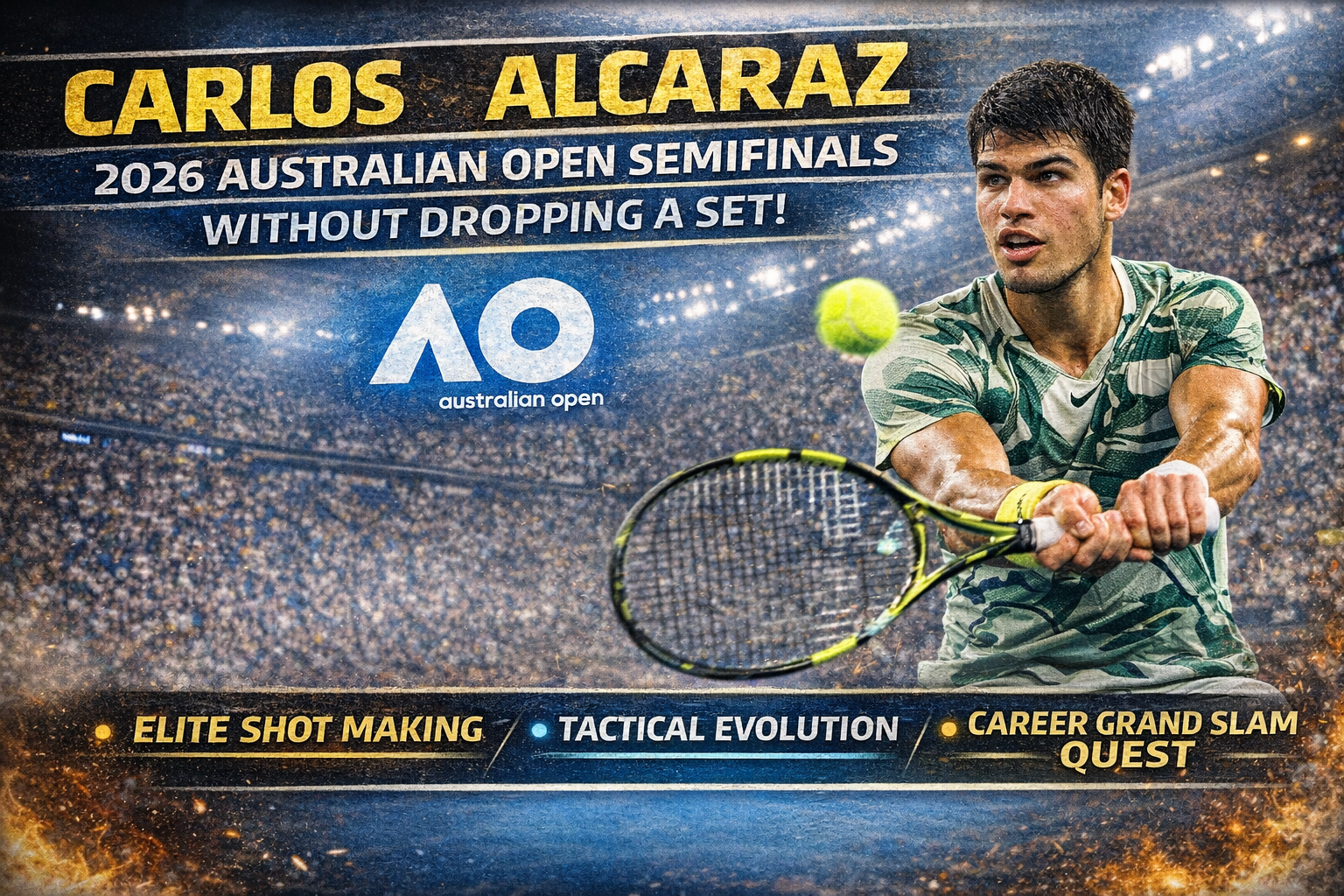
Introduction: A Pivotal Grand Slam Chapter
Carlos Alcaraz entered the 2026 Australian Open as the world No.1 and one of the defining players of his generation. His progression to the semifinals marks the first time he has reached this stage in Melbourne, continuing a trajectory that could see him complete a Career Grand Slam at the age of 22. His ability to advance without losing a set underscores both performance dominance and psychological consistency on hard courts.
Early Rounds: Tactical Precision and Competitive Control
Alcaraz’s early matches in Melbourne highlighted his combination of power, court coverage, and situational awareness. Against Alex de Minaur in the quarterfinal, he maintained composure through fluctuations in first-set momentum, then imposed tactical variation to dominate subsequent sets. His ability to shift between baseline aggression and deft angled shot placement disrupted a highly motivated opponent.
Across those rounds, Alcaraz demonstrated strategic balance. His serve placement reduced counterattack opportunities, his forward movement kept opponents from settling into rhythm, and his aggressive returns controlled baseline exchanges. The effectiveness of these elements underlined not just physical superiority but nuanced tactical execution in high-stakes match conditions.
Semifinal Matchup: Resilience Under Duress
In his semifinal against Alexander Zverev, Alcaraz faced both physical challenges and competitive pressure. He endured periods of cramping late in the match, a factor that often disrupts shot rhythm and positional balance. Despite this, he managed key service holds and manufactured point construction through drop shots, occasional lobs, and penetrating groundstrokes that kept Zverev defensive.
This match highlighted a defining aspect of elite tennis performance. Alcaraz’s ability to execute under duress showed both mental resilience and depth of strategic repertoire. While cramping could have diminished his range and explosive movement, it became a narrative of controlled aggression where timing and decision quality compensated for reduced physical capacity.
Tactical Evolution: Adjustments Against Top Tier Opponents
At this stage of his development, Alcaraz’s tactical identity continues to balance aggression with structure. Against Zverev, who posed challenges with his serve and heavy groundstrokes, Alcaraz engaged in calculated risk taking rather than sheer power through every rally. He varied depth, constructed points to Zverev’s weaker wings, and targeted situations where his movement could extract errors.
This evolution from all-out offensive explosiveness to more nuanced point orchestration reflects a maturation in Alcaraz’s game. It aligns with trends visible in his 2026 season overall, where adaptability and anticipatory positioning have become as critical to outcomes as physical talent.
Broad Significance: Legacy and Career Arc
Alcaraz’s run at the Australian Open grows the narrative arc of his career. Already a six-time Grand Slam champion, he has built this reputation through a combination of junior era success and elite professional execution. Possessing an aggressive baseline game, elite fitness, and keen situational instinct, his potential Career Grand Slam at 22 would place him among the youngest in the Open Era to achieve such a milestone.
Reaching this point without dropping a set also speaks to his ability to manage both tactical variation and mental resilience across multiple matches. Consistency in managing pressure through diverse strategic scenarios enhances his standing not just as a dominant tournament performer, but as a player capable of evolving under the sport’s highest competitive stress.
Comparative Context: Rivalry Dynamics and Tour Landscape
Alcaraz’s story is interwoven with the broader elite field. Jannik Sinner remains a formidable rival, and Novak Djokovic, at age 38, continues to assert competitive relevance at Grand Slams. Both players exemplify contrasting generational pressures that Alcaraz must navigate to solidify his legacy. The depth of this competitive field makes his current Grand Slam performance both technically and psychologically significant within men’s tennis.
Conclusion: Tactical Clarity and Competitive Fortitude
Carlos Alcaraz’s journey through the 2026 Australian Open captures not only a sequence of match results, but a comprehensive portrait of strategic progression and competitive fortitude. His offensive versatility, adaptation under physical stress, and consistent decision-making have propelled him into career-defining territory. How he responds in the remaining matches will directly influence narratives about his place in tennis history, particularly if he completes a Career Grand Slam at an age younger than most in sport history.